
Storing Your Summer Shoes Before Autumn: The Complete Guide
Summer is winding down, sandals are heading back to the closet, and closed shoes are reclaiming their spot by the door. Yet the way you go about storing your summer shoes largely determines what condition they'll be in next season. Leather that dries out, a sole that loses its shape, a colour that fades: most of the damage we notice come spring rarely comes from wear during the summer itself — it comes from careless storage over winter. Between the humidity that builds up in a poorly ventilated closet, the dust that settles over months, and the weight of other pairs stacked on top, storage conditions often matter more than how much a shoe was actually worn. The good news is that a few simple steps, done at the right time, are enough to preserve the material, the shape and the finish of every pair. In this guide, we'll walk through cleaning, caring for and properly storing sandals and lightweight summer shoes, so you find them next season looking just as good as the day you bought them, whatever the finish: smooth leather, crackle leather or python-effect leather. A little method now means far fewer bad surprises when the warm weather returns.

Why end-of-season storage makes all the difference
What really damages a shoe over winter
Contrary to popular belief, it isn't summer that wears a pair of sandals down the most — it's the winter spent waiting for them. Shut away in a box, a plastic bag, or simply stacked at the back of a closet, leather keeps trying to breathe, and struggling to do so. Without proper airflow, residual humidity lingers and encourages mould and unpleasant odours. Accumulated dust acts as a quiet abrasive with every bit of friction. And the weight of other pairs on top eventually flattens the shape, warps the heel, or snaps a delicate strap. It's this combination of humidity, dust and pressure that explains why a shoe can come out looking tired after months of sitting still, even though it held up perfectly well all summer long. Temperature swings play a role too: a closet against an exterior wall, or a poorly insulated space, puts leather through more stress than a single season of sun ever would. None of these factors are dramatic on their own, but combined and left unchecked for months, they add up to a shoe that looks noticeably older than its actual amount of wear would suggest.
The step most people skip (and regret)
The most common habit, and the most damaging one, is putting shoes away right after the last wear of the summer, with no step in between. They come off, go into the closet, and aren't thought about again until next spring. But this is exactly the shortcut that causes the most harm: sweat, sand, sunscreen or dirt residue left on the leather keep working on the material chemically for months, even once the shoe is sitting still. Cleaning and letting a pair dry properly before storage takes only a few minutes per pair, yet makes a real difference when the closet reopens. Compare two similar pairs, one cleaned before storage and one left as is, and the gap is obvious: the first keeps its original colour and softness, while the second often shows watermarks, a duller leather, or a lingering smell. Once it becomes a habit, this small end-of-season ritual takes no more time than a regular polish.

Step 1 — Clean before you store
Dusting off and removing the season's wear
Before anything else, every pair deserves a gentle clean. A soft, slightly damp cloth is enough to lift off dust, sand or residue on the upper as well as under the sole. On leather finishes, avoid harsh products or hot water, which can dull the colour or weaken the material over time. Straps, seams and friction points deserve particular attention: these are often the first places where dirt settles without you noticing. This basic clean, quick as it is, stops organic residue from working its way into the leather during the months of storage. Don't forget the inside of the shoe either: the insole carries its own trace of the season, between sweat and fine sand. A light dusting inside, paired with a natural deodorizer, keeps odours from settling in for good inside a closed shoe over several months. It only takes an extra minute per pair, but it's the kind of detail that separates a shoe that smells fresh in spring from one that needs a full clean before it can be worn again.
Air-drying before any storage
Once cleaned, a shoe should never be stored while still damp. Let it dry naturally, at room temperature and away from direct sunlight or a heat source, both of which can harden or crack the leather. Allow at least 24 hours for a pair simply cleaned with water. This is also the right moment to apply a suitable treatment: our care guide covers the products and steps recommended for each finish, to nourish the leather before it rests for several months. Avoid drying a damp pair near a radiator or with a hairdryer: rushing the process makes leather lose some of its natural elasticity and can, over time, cause small, irreversible cracks. Slow drying at room temperature remains the safest method by far.
Step 2 — Match the care to the material
Crackle leather, a finish to hydrate before storage
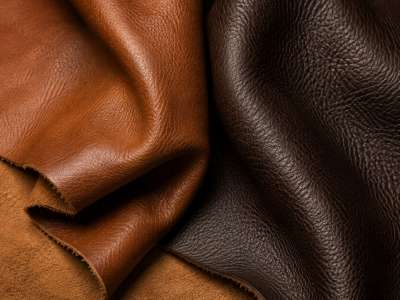
Our crackle-leather finishes, such as the Orea sandal, owe their character to leather worked to reveal fine surface cracks. As striking as this texture is, it needs particular attention before a long stretch in storage: leather left dry for months tends to lose suppleness, and existing micro-cracks can deepen. A thin layer of nourishing cream, applied and left to absorb before storing, helps the material keep its flexibility and stops the desired crackle effect from turning into real fragility. Contrary to what you might think, crackle leather actually needs more care than smooth leather, not less — the textured surface exposes more of the material to the air, meaning more areas prone to drying out over a long storage period. A light touch-up every couple of months through winter helps keep the leather supple until the warm weather returns.
Python-effect leather, protecting it from light and friction
On patterned finishes, like the python-effect leather of our Laori sandal, the main threat isn't humidity but direct light, which can dull the depth of the pattern over the months. It's best to store this type of piece away from sunlight, ideally in a closed box or a fabric pouch rather than a sealed plastic bag. Avoid stacking another pair directly on top, too: the raised pattern is more sensitive to repeated friction than a plain smooth leather would be. A soft cloth pouch or fabric cover is usually enough to create a protective barrier, without trapping moisture the way a sealed plastic bag would. It's a simple precaution, but one that makes a real difference in keeping the pattern's depth intact over several seasons. It's also worth remembering that an embossed pattern, however subtle, reflects light slightly differently from a plain surface — which is exactly why prolonged sun exposure tends to flatten its contrast faster than on a smooth finish.
Smooth leather and softer materials, the express routine
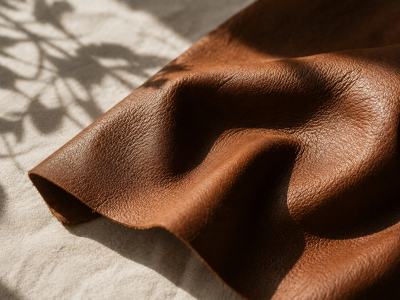
For smooth leather finishes or softer materials, pre-storage care stays simple: a light clean, a thin layer of colourless moisturising cream, and full drying is enough. These materials generally handle extended storage better than more textured finishes, as long as they aren't folded or crushed under other pairs. A shoe tree, even a basic one, keeps the toe shape intact and prevents unsightly creases from forming by the time the closet reopens. For very soft, unstructured styles, a piece of crumpled tissue paper tucked inside can do the job just as well without needing a dedicated shoe tree — the goal is simply to stop an empty, soft shoe from collapsing on itself over several months.
Step 3 — Store it properly for winter
Once cleaned, dried and nourished, your shoes are ready for storage that will actually protect them. This is the step that decides whether a pair comes back out in spring looking just as good, or whether it will have lost some of its shine during the wait. The container, the location and a few small accessories make far more of a difference here than the number of months spent in the closet. A few thoughtful choices at this stage cost almost nothing, yet they're what separates a pair that comes back looking tired from one that looks ready to wear again straight away.
- Shoe trees: slipped into closed or semi-open styles, they hold the shape of the toe and arch, and absorb some of the residual moisture.
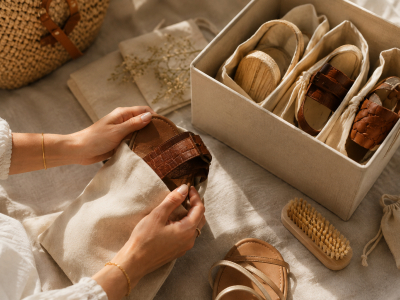
- Individual boxes: better than loose storage in a bin, boxes prevent weight and friction between pairs, especially for worked leathers like crackle, python or patent finishes.
- Moisture absorbers: a few silica gel packets or a piece of chalk tucked into the box will absorb ambient humidity throughout the storage months.
- Storing flat: avoid stacking boxes without a shelf; the weight always ends up marking the most fragile material, at the bottom of the pile.
- A mid-winter check: a quick check partway through winter, airing shoes out for a few minutes and checking for odour or dampness, lets you catch a problem early before it gets worse.
As for location, choose a closet or wardrobe with a stable temperature, away from humidity (skip the basement or the bathroom) and out of direct light, which remains one of the main causes of leather discolouration over time. A simple, well-ventilated shelf, away from a radiator, is more than enough to protect your sandals through the winter months. One last detail worth the effort: labelling or photographing what's inside each box before closing it. It might sound trivial, but when several pairs of sandals look alike, being able to find the right one without unpacking everything also means less unnecessary handling of the other pairs, and less of the repeated friction that wears materials down over time.
In short
Storing your summer shoes doesn't have to be a chore: clean them, let them dry, nourish the material according to its finish, then store away from humidity and light. A few minutes per pair is all it takes, for a result you'll really notice when the closet reopens next spring, and the leather is back to its full softness and original colour.
This approach works just as well for a pair worn a handful of times as for something more precious, saved for special occasions. Either way, the principle stays the same: it's worth spending a little time at the end of the season rather than waiting until spring to discover the damage. And if you're ever unsure about the right product or technique for a particular material, it's always worth checking first, rather than risking a delicate finish with the wrong product.
Need a refresher on the right care routine for your leather type? Find all our tips in the Reqins care guide.
Share this content


